
Building a Low-Impact Fire Pit in Wet Ground
The Hearth Is the Oldest Kitchen
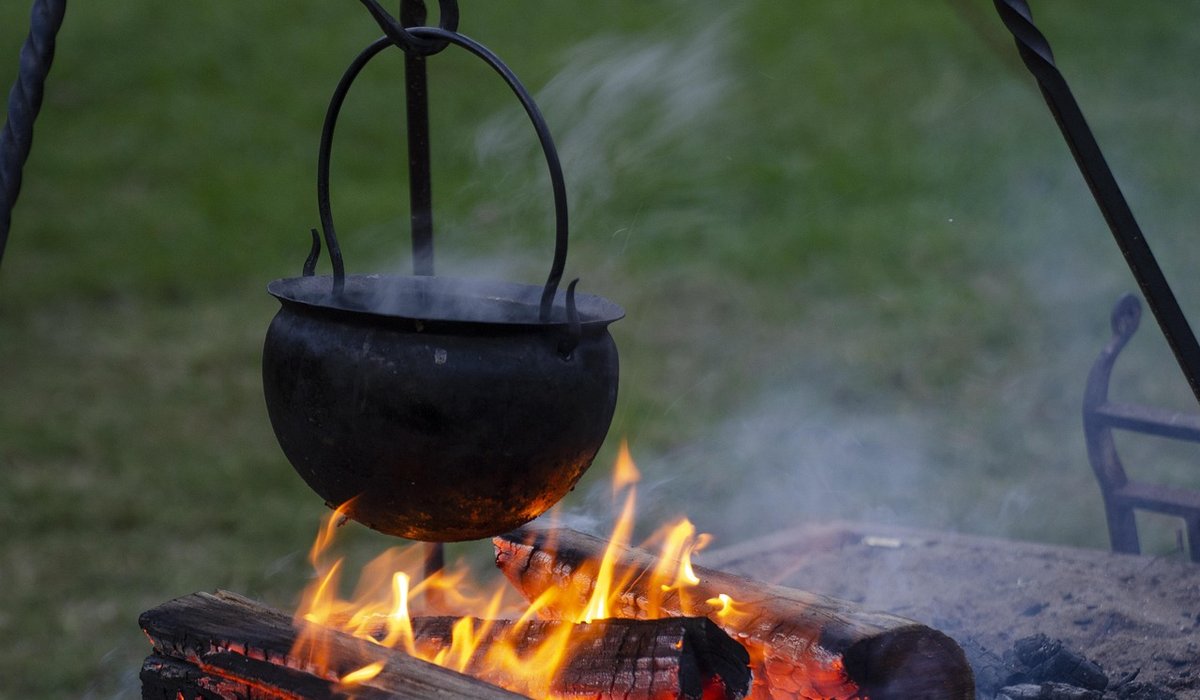
There is a particular hour in a British autumn — the light going soft about four o'clock, smoke lying low over the field — when a fire stops being decorative and starts being useful. Long before ovens and hobs, the hearth was the whole kitchen: a ring of stones, a pot set into the ash, and the patient business of waiting. Household fires were banked overnight and coaxed back to life in the morning, and a need-fire was kindled from scratch when matters went badly. You need not believe any of it to feel the pull of it. Stew is only attention paid slowly, and the fire does it more honestly than a gas ring.
Choose Your Base: Meat, Pulse or Both
You want something that gives up its collagen and thickens the liquid as it goes. For about six people:
- Beef shin or cheek, 1kg, cut into large 5cm pieces — the best choice for a long sit by the fire.
- Lamb shoulder, 1kg, or middle neck, on the bone if you can get it.
- Venison haunch, 1kg, cubed — leaner, so add a little extra fat.
- Smoked bacon lardons, 150g, or a handful of dried mushrooms, for depth.
- Pulses instead: 300g dried butter beans soaked overnight, 200g brown lentils, or 100g pearl barley. Tinned beans go in for the last twenty minutes only.
Brown the meat hard and in batches — crowd the pot and it steams, give it room and it colours. Render the lardons first and use their fat. Then splash in ale, cider or water and scrape the bottom while it hisses; that sticky layer is the whole flavour of the finished pot.
Roots, and the Order They Go In
Roots are not interchangeable. Dense ones need a head start; soft ones dissolve if you are careless. Roughly 1.5kg in total, cut into pieces about the size of the meat.
- First, with the browned meat: swede, celeriac, carrot, quartered onions or whole peeled shallots, a head of garlic cut across the middle.
- An hour later: parsnip, potatoes, a couple of quartered leeks.
- Last ten minutes: chopped greens, a spoon of mustard, a slosh of Worcestershire sauce, salt to taste.
Thyme, bay and rosemary suit embers, plus a pinch of juniper if you have it. Add 1 to 1.5 litres of hot stock or water with the roots — halfway up the contents, no more. You can always reduce at the end, but you cannot un-salt.
Working with Embers, Not Flames
This is where most campfire cooking goes wrong: people cook over flames and get smoke and scorch. Flames are for light and drama. The heat is in the embers.
Burn hardwood — oak, ash, beech, birch, apple. Avoid resinous softwood and anything painted or treated. Let the fire burn down for forty minutes or so, until the logs have broken into grey-crusted coals with a deep orange glow beneath. Rake them into a bed, sit the pot on a trivet or three stones, and draw a ring of embers around the base. Put a few on the lid as well, so the heat comes from both sides.
You are after a lazy blip — a bubble every second or two — not a rolling boil. If it is too fierce, scrape embers away from the base; if it falters, add one or two coals from a small feeder fire burning nearby. Top up with hot water, never cold, and only as much as you need. Two and a half to three hours for shin or shoulder, around ninety minutes for pulses and barley.
Tales for the Waiting Hour
A stew that takes three hours asks to be entertained, and a fire is a better screen than any. British folklore is full of hearth-keepers: the brownie and the hob, small helpful things that took their bowl of cream by the fire and left for good if they were thanked or spied on; the boggart that followed a family from house to house; the fire that must never be let go out.
You do not have to be a performer. Pick one story, keep it under eight minutes, and hold a single image in your head — a bowl left on the hearthstone, a light seen across a field. Folktales come in threes: three brothers, three tasks, three chances. Let the fire cover the pauses. Hand the last line to a child if you have one. Finish when the smell of the stew starts drawing people in, then lift the lid.
Serve It in the Open
Take the pot off the heat and let it sit for ten minutes, lid off, so the steam settles. Bread and butter, or a potato baked in the ash earlier, is all it needs. Eat outdoors if the weather allows; the last of the smoke and the first of the stars are part of the meal. Scatter the dregs over the fire, drown the embers properly, and leave nothing but water and cold ash. Then walk home smelling of woodsmoke — for a great many of us, the oldest smell of a good evening.
LEAVE A COMMENT